

Russia has a name for neighbors that aren’t supposed to have their own foreign policy: the Near Abroad. It’s a wonderfully dialectical term, each half negating the other to create an imperial synthesis that treats sovereignty as a plaything of the Russian imagination. “Which countries border the USSR?” asks the school quiz in the Soviet joke. Correct answer: “Whichever ones it wants.”
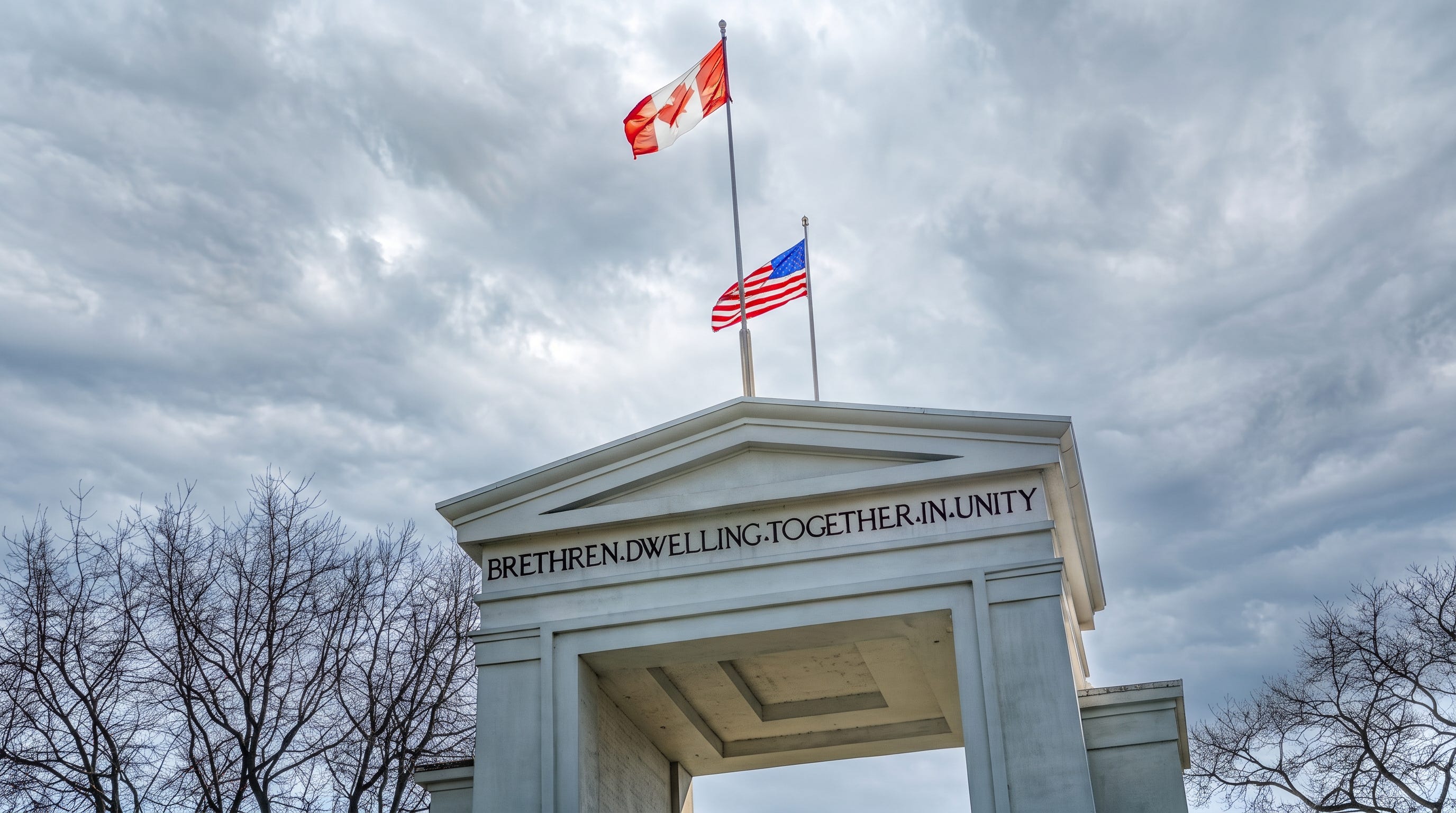
I have a new piece in Survival comparing Trump’s treatment of Canada with Putin’s treatment of his own neighborhood. With Canada, as with Venezuela and Greenland, Trump has now acquired his own Near Abroad. Real places, to be sure, but not real in the same way America is real, and thus subject to poking and prodding and the occasional presidential kidnapping by the hegemon.
Ever since the big happy family fell apart in 1991, Moscow has deployed a reliable set of tools to keep its runaway children in line. This means cutting off their trade, questioning whether they are real countries, and cultivating separatists inside their borders. Trump is now using the same toolkit against Canada: economic coercion, annexationist rhetoric, and support for internal separatist movements.
I won’t go into them here (the article does), but each of these three elements have been a key part of Trump’s Canada policies.
The result has been a cultural and political rejection of America as a concept, let alone a neighbor. (Yes, America stands for bad things now. I’ve seen it firsthand.) The tragic irony is that until recently Canada barely considered itself “abroad”, near or otherwise. Until 2009 Americans could drive there without a passport, as I did with my high school friends to get into bars before we were 21. Those days are long gone.
Why the parallels? I think it’s because both Russia under Putin and the US under Trump share a vision of international order built on spheres of influence, in which great powers have the ultimate say in their neighborhood. Smaller states comply or face punishment. The same logic that places Canada in Trump’s sphere also places Ukraine in Putin’s, which helps explain Trump’s deference to Moscow over the war.
Post-Soviet states responded to Russian pressure by diversifying their relationships and Canada is now doing exactly the same: joining European Union defense-procurement efforts, ordering submarines from Germany, and signing trade agreements across Asia and Europe.
Russia screwed up badly by trying to be a 19th century regional hegemon after recovering from the Soviet collapse. But it’s the only thing it knows how to do. Coercion was supposed to keep its neighbors inside its sphere of influence, but instead accelerated their departure.
The US is now repeating Russia’s mistakes with a neighbor that was until recently the closest ally in America’s own fading order. That to me is the craziest part. Russia usually coerces neighbors trying to leave its orbit: Georgia after the Rose Revolution, Ukraine after the Orange one, Moldova whenever it looked West. Its motives are at least legible: it wants to rebuild an imperial sphere and stop resentful neighbors from leaving. Trump is instead creating resentful neighbors who hadn’t considered leaving until now. He works from an older idea of global order that rejects Westphalian sovereignty in favor of personal fealty. Under that logic Canada’s offense was probably insufficient gratitude. Welcome to the neo-feudal world.
You don't find the US's less recent history in latin America and the Pacific to be consistent with Russia's attitude towards its neighbors? I'm reminded of Diaz's saying, "Poor Mexico, so far from God, so close to the United States."
It seems to me that behavior that we've historically reserved for less developed parts of the western hemisphere are now being applied (albeit haphazardly at best and nonsensically at worst) to developed countries such as Canada and Greenland. The USA has always been an imperial power, just with some ideological commitments to being nice about it.
"He works from an older idea of order that rejects Westphalian sovereignty in favor of personal fealty."
I think this can be pushed farther; rejection of the Enlightenment is a common thread throughout the actions of the Trump regime. Obviously, there is the war on science and medicine, and the insistence on the validity of arguments from authority, when the authority is Trump.
But consider this essay by Alexander Gamburd, "The Siren Call of the Silicon Leviathan" (https://arxiv.org/abs/2609.28591). Gamburd argues the focus of AI companies on mathematics can be read as an attack on the core epistemic values of the Enlightenment:
"Over three centuries ago ... a new approach to knowledge production and dissemination, conceived in distrust of authority, and dedicated to the proposition that truth is accessible to human reason. Mathematics, the Enlightenment's firstborn, was its existence proof--knowledge that compels assent without appeal to authority--because the only way to make a theorem certain was to show it to a human mind. Now we are engaged in an existential struggle testing whether mathematics, or any discipline so conceived and so dedicated, can long endure ... A proof has historically been two things: a certificate that a theorem is true, and a demonstration that lets another person see why. OpenAI delivered the first without the second. But, in a larger sense, what matters is not what the Silicon Leviathan ... produces but rather what we accept. By accepting the certificate without the demonstration, we adopt the Hobbesian bargain: authority, not truth, makes the law."
My point here is that from this perspective, Trump has a natural affinity with the AI companies.