
The Two Mearsheimers
the best argument against his Russia theory is in his own work

There have been so many criticisms of Mearsheimer that I doubt anyone cares at this point. But I wanted to raise something rarely mentioned: M. is not actually making a realist argument. Which is ironic given how much damage he has done to the realist brand.
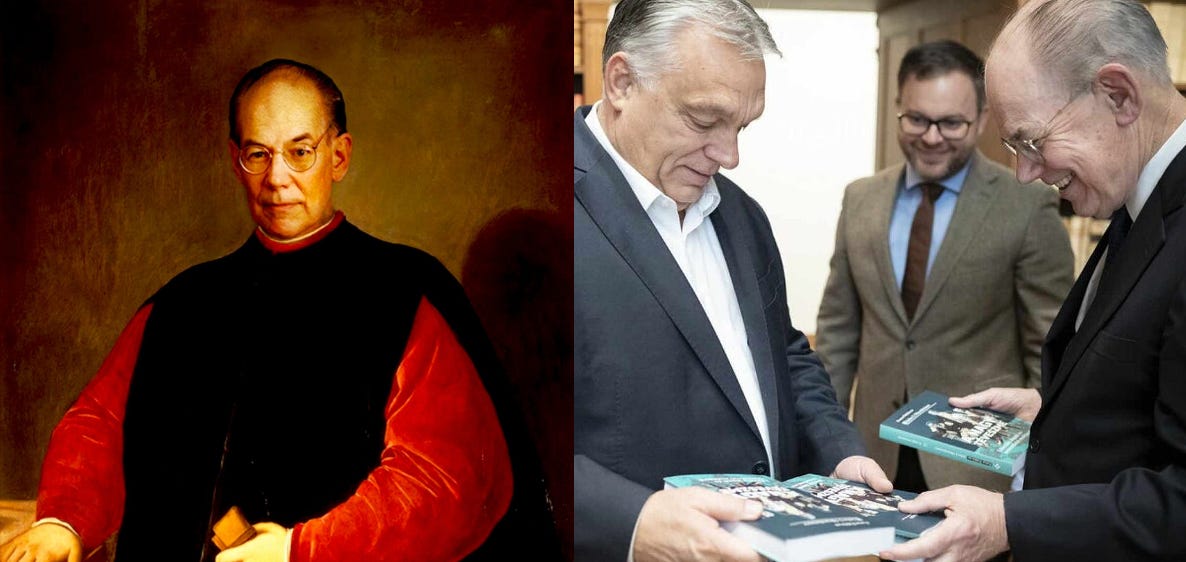
I’m going to share a secret only political scientists know about. There are actually two John J. Mearsheimers. The first one wrote The Tragedy of Great Power Politics (2001) and says powerful states are dissatisfied by nature, and will go to war whenever they can. The second one, born in 2014, disagrees. Yes, states go to war because it’s the central feature of political life — except Russia, who goes to war because of American liberals. The first Mearsheimer is a theorist of international anarchy. The second is a moralist of American sin. The two have never met, but if they did they would hate each other.
How does Mearsheimer 1.0 explain Russian behavior? For answers we have to look at Mearsheimer’s theory of offensive realism, which first brought him to prominence. Here the answer is simple: Russia is a great power, and great powers “are rarely content with the current distribution of power.” In fact, “they face a constant incentive to change it in their favor.” (p.2; quotes are from the Tragedy of Great Power Politics, the ur-text of offensive realism.) This is what makes war an eternal feature of international politics. Powerful states do not need external prodding to become aggressive:
This unrelenting pursuit of power means that great powers are inclined to look for opportunities to alter the distribution of world power in their favor. They will seize these opportunities if they have the necessary capability. Simply put, great powers are primed for offense.” (p.3)
Great powers are especially likely to be aggressive and predatory to weaker states along their borders. “A great power that has a marked power advantage over its rivals is likely to behave more aggressively,” Mearsheimer says, “because it has the capability as well as the incentive to do so” (p.37) In the absence of a credible external enforcer, your ability to do what you want has a lot to do with material resources. When their relative capability shrinks, great powers cannot afford to be as aggressive. But when they are on the rise, the aggression gets turned up.
The realist theory of Mearsheimer 1.0 is actually a very good description of Russian behavior. Consider, for example, the years from 1917 to 1924. The Romanov collapse weakened the regime, allowing secessionist movements to splinter off along the edges. But as the center regained strength, it brought those fledgling proto-states back into the imperial fold with force. From the perspective of Mearsheimer 1.0 there’s nothing unusual here. Whether it’s re-gathering the empire after 1917, the Soviet interventions in Hungary and Czechoslovakia, or the 2022 invasion of Ukraine — all plainly signal the workings of offensive-realist logic, in which a regional hegemon seeks to dominate its neighbors to the extent allowed by its relative power.
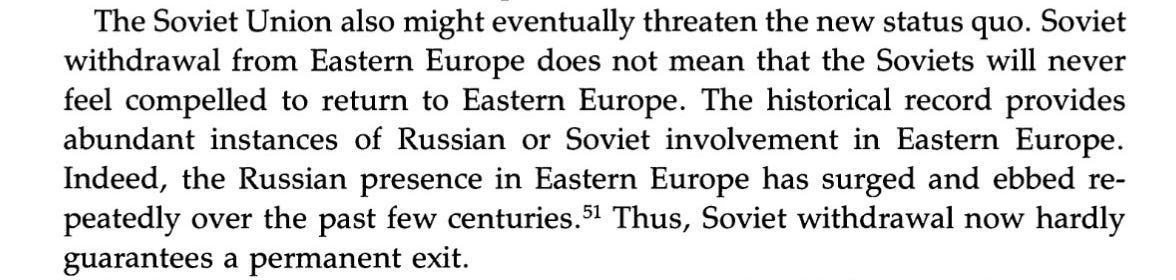
This is something Mearsheimer 1.0 had often noted himself. Looking at the world in 1990 and observing Gorbachev’s pullback from Eastern Europe, he wrote:
(Source)
A decade later, in Tragedy, he noted that “Russia had a rich history of expansionist behavior before the Bolsheviks came to power in October 1917.” Describing the empire’s four centuries of continuous expansion, he concluded: “There is considerable evidence that Vladimir Lenin, Josef Stalin, and their successors wanted to follow in the Tsars' footsteps and further expand Soviet borders.” (p.190)
This long history of Russian imperialism has faded away in Mearsheimer’s newer writing. In fact, Mearsheimer 2.0 has largely left history behind in favor of focusing on American statecraft. For him, Russian behavior is therefore kind of a puzzle. Why would Russia do something stupid like invading Ukraine? The answer is that their hand was forced. By whom? By utopian western liberals, who made gestures at Ukraine joining the West. No matter that the prospect of NATO membership was not a serious possibility until after the invasion. The very possibility of Ukraine entering the West was enough to provoke Russia into war.
Of course, Mearsheimer might say. My theory predicts that great powers don’t tolerate competitors or their arms in their regions. But this is realism selectively applied. Despite his emphasis on great powers as the great movers of history, Mearsheimer is oddly reticent about giving Russia the same agency as the United States. It’s American bureaucrats that make choices - the Kremlin simply responds. The emphasis on interaction under uncertainty, which is the core of realist thought, has been stripped away. Instead, it simply becomes America’s fault. The long history of Russian imperial revanchism, which Mearsheimer himself has detailed, has faded into the background.
For all its faults, offensive realism does a decent job of explaining the behavior of aggressive expansionist states like Russia — if only the theory’s foremost practitioner would recognize that fact! As he notes, opportunistic aggression against weaker neighbors is not surprising or unexpected. As he also notes, it is inherent to how great powers behave everywhere, and generally requires no external stimulus to explain. In fact, given Russian history, it would hardly be surprising at all. That’s the explanation for Russian behavior found in Mearsheimer’s principles of offensive realism. It is, however, largely missing in Mearsheimer’s post-2014 explanations.
During the Cold War, debates raged about who was to blame for starting the conflict between the US and USSR. The answers fell into three categories, crudely speaking: traditionalists, who blamed the USSR; revisionists, who blamed the US; and post-revisionists, who blamed the uncertainty and mutual suspicion created by the anarchy of international politics.
The arguments around the Russia-Ukraine war have now recapitulated these debates, with the question being not who started the Cold War but who re-ignited it. Mearsheimer has taken the equivalent of the revisionist side: America did it. Doing so makes sense as a counterargument to conventional wisdom: Putin did it. But by blaming one state, Mearsheimer has robbed his argument of the strategic context that realists themselves correctly emphasize. Even before the 2022 invasion, for example, Sushentsov and Wohlforth (2020) argued that tension over NATO is best understood as an “offensive realist tragedy” of escalating mutual distrust.
I’m not the only person to have made this point repeatedly on Twitter - Paul Poast has also been reiterating it over the years, most famously and eloquently here:

In short, to make the case against liberals, Mearsheimer 2.0 abandons both the lessons of Russian history and key tenets of his own theory. This is especially ironic given how much his pronouncements have damaged the reputation of realism both inside the academy and among the public.
Now you know. We have unwittingly been arguing about two incompatible people: the 2001 Mearsheimer of Tragedy, who focuses on anarchy and uncertainty as the structural source of global conflict, and the post-2014 Mearsheimer of The Great Delusion, who instead sees American liberalism as the source of that conflict. The great tragedy of offensive realism is that in the process of seeking a culprit for the war, Mearsheimer has left his own theory behind.
Nice piece! Russia's pre-2022 reputation in parts of Western academica (particularly coming off the heels of Iraq) as a sometimes ruthless but rational and restrained actor exemplifying the tenets of realism in its 'non-ideological' foreign policy retrospectively on some level is an interesting look at its success in branding and a certain Cold War nostalgia for an 'honorable' defeated foe that transcended left/right lines. They leaned into this framing, borrowing some aspects from the Soviet era, very hard prior to 2014 and it really worked! I always found full-throated justifications of Russia's actions in 2014 and in Syria analytically and morally suspect but even when looking at my own writings from pre-invasion grad school I tend to shake my head a bit at my naivety, borne out of the intellectual climate around these issues.
A significant part of Mearsheimer's descent imo came from his (and many others') obsession with pulling off a Nixon in China strategic masterstroke in reverse where the US would abandon its pesky fealty to ideas and team up with the sober minded Russians to counter China ala Clancy's Bear and the Dragon and, somewhat ironically given their Hard Men self-perception, a strong sentimental attachment to this idea and towards Russia's position in the world in general couldn't survive exposure to what it was actually becoming under late Putinism and resulted in the deepening derangement we see today, to the detriment of their own valuable theoretical model!
Mearsheimer mixes normative and descriptive analysis whenever it suits his prejudices. Israel is nine miles wide at the middle and yet discounts every single one of its security concerns. Meanwhile Ukraine or NATO has never suggested any territorial designs on Russia and yet he supports their conquest and domination of surrounding territory for purely imperialistic reasons.