

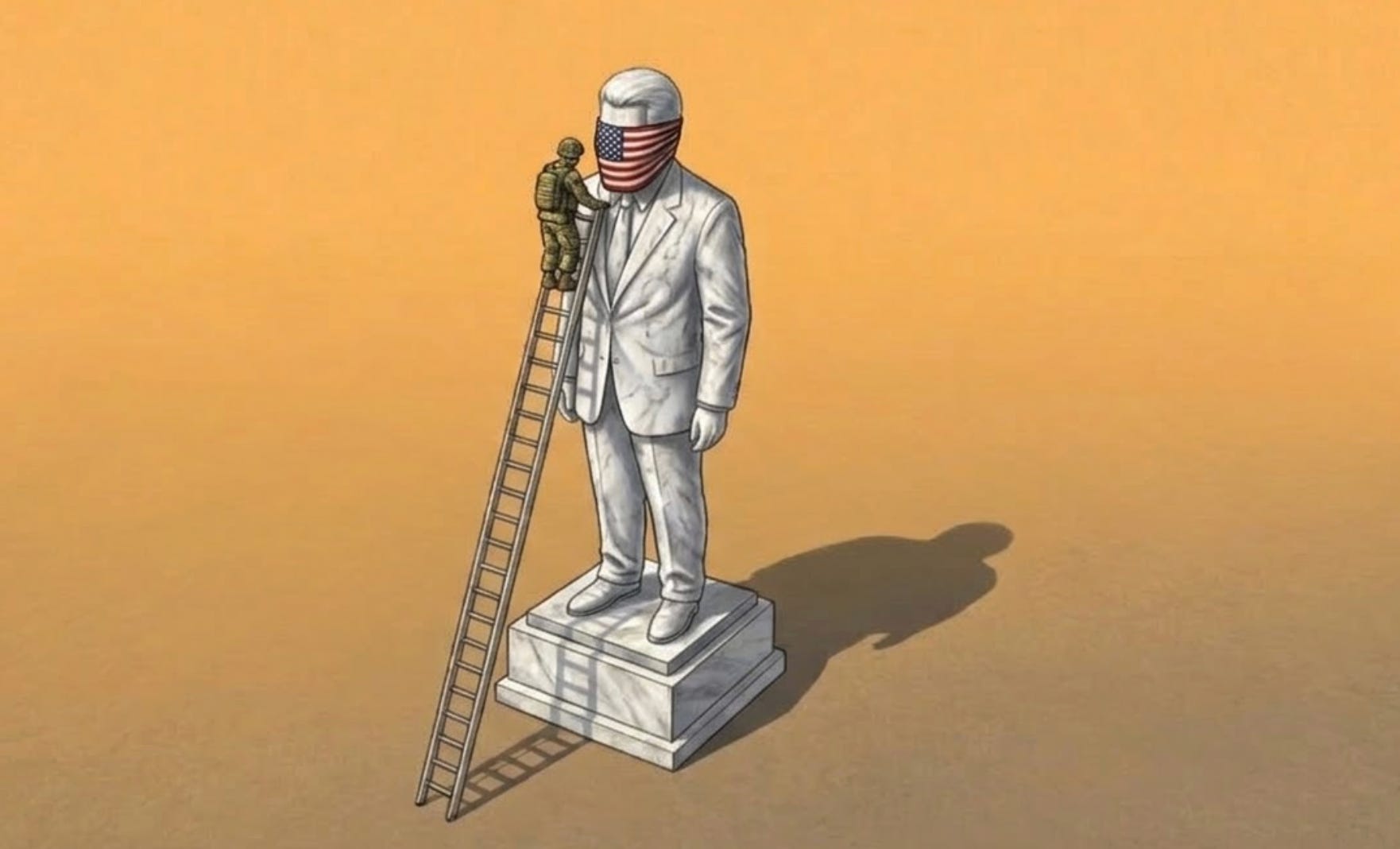
Time has a way of compressing history. The Hundred Years’ War was a series of three separate wars that must have felt as distinct to its contemporaries as the World Wars feel to us now. But those three wars were a long time ago, so we lump them together into one conflict. Besides, we are wise. We have seen the direction of History and know they were all fought over the unresolved question of England’s rivalry with France.
I suspect future historians will apply the same compression to the three Gulf Wars of the unipolar era. While 1991, 2003, and 2026 are distinct in many ways, they all revolve around repeated attempts by the hegemon to impose its order on a region it appears to understand less and less each time.
Together the three conflicts trace the full hubristic arc of America’s unipolar moment, from its triumphant emergence in 1991 to its arrogant peak in 2003 to its current retreat. Each phase of the Long Campaign is defined by increasing contempt for the rest of the world and growing disconnect from its own national interest. In 1991, the United States had a reason to fight; in 2003 it manufactured one; in 2026 it didn’t even bother. Maybe this time the bombing was “out of habit,” Trump explained recently, which, he qualified, is “not a good thing to do.”
And there is a feedback loop across the three wars, with each intervention producing the crisis the next intervention was meant to solve.
It’s a common imperial problem.
The First Gulf War was the coronation of a new world. A 34-nation coalition, UN authorization, Arab states fighting alongside NATO. The USSR stood by meekly, Gorbachev pathetically begging for more loans. The coalition liberated Kuwait and stopped: a miracle! The hegemon actually working within the rules it claimed to uphold. This restraint preserved the legitimacy of American primacy but also left unfinished business for the next war.
By the second war everything present in 1991 was degraded or absent. The coalition was thinner and there was no Security Council authorization. The casus belli of WMDs was contested before the invasion and collapsed shortly after. I worked at a DC think-tank in the run-up to the invasion, and remember asking Richard Perle: what if you don’t find weapons of mass destruction? Impossible, he said. The war eliminated Iran’s most powerful rival, creating space for proxies like Hezbollah, the Houthis, and a variety of Iraqi militias.
And so to the Third Gulf War. On February 28 the United States and Israel launched airstrikes across Iran and killed Supreme Leader Ali Khamenei along with members of his family. The strikes came one day after Oman’s foreign minister announced a breakthrough in talks. Peace, the mediator said, was “within reach.” Three weeks into the war, the Strait of Hormuz is functionally closed for commercial shipping and a fifth of the world’s oil supply is offline.
Each subsequent war stripped away another layer of hegemonic restraint, with the legal justifications thinning and the deference to allies vanishing. The role of Israel traces this arc nicely. In 1991, Israel had to be actively sidelined. Saddam launched missiles at Tel Aviv to provoke an Israeli response that would break the Arab coalition, and the American diplomatic effort focused on keeping Israel out of the war. Bush pressured Shamir not to retaliate and deployed Patriot batteries as consolation.
In other words, in 1991 Israeli involvement had to be suppressed for the multilateral framework to hold. But by 2003, Israeli strategic interests had moved into the background. The neoconservative case for remaking the Middle East overlapped heavily with Israeli strategic thinking, even though Sharon privately told Bush that Iran was the real threat. Israel’s role was part of the war’s intellectual scaffolding without being visible on the battlefield.
In 2026, there is no hidden scaffolding anymore. The United States and Israel launched the war together as open co-belligerents. The evolution of Israel’s role from suppressed to implicit to explicit reflects the pattern of increasingly unconstrained American behavior. Things that had to be hidden in 1991 to maintain coalition legitimacy are now done openly with no concerns for either coalitions or legitimacy.
The erosion is not just due to Trump, since the crucial break was 2003. Bush invented a casus belli and established the precedent that the hegemon could wage elective war. Trump is doing something dumber but less radical by operating in the space Bush opened.
The Hundred Years’ War eventually had a winner: France reclaimed its territory and England’s continental ambitions were finished. Who wins the Gulf Wars? Not Iran certainly, but not the United States either. Four decades of the same hegemon trying to impose its will on the same region, shifting from multilateral restraint to unilateral preemption to something so thoughtless it doesn’t need naming at all. Maybe Trump is right. At this point, it’s just habit.
Excellent historical overview, thank you. Domestically, we see the rise of MAGA Fascism as an accelerant to the advent of toxic hegemony.
US leadership is indifferent to (repeatedly) touching the hot stove because they’re not the part of the apparatus that is burned. Many solutions to fix that, why are we unable to create diplomacy with states like Iran? Saudi Arabia has many rough spots but friendly relations remain.