

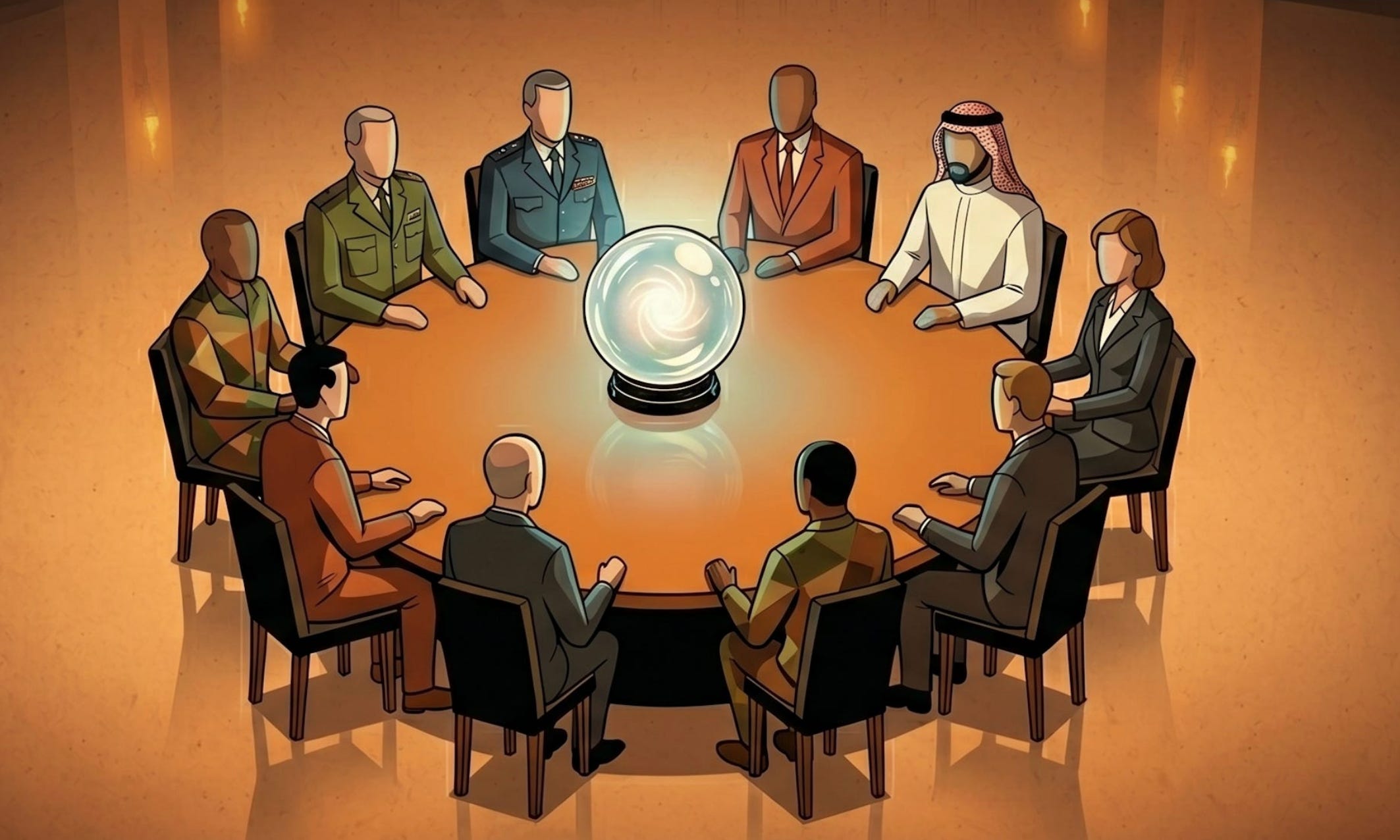
On February 17, 2022, one week before Russian tanks rolled into Ukraine, Boris Johnson convened a seminar of experts at 10 Downing Street. He wanted to know: would Putin actually do it?
The group included Mark Galeotti, a long-time Russia expert; Lawrence Freedman, a noted military historian; Rod Lyne, a former UK ambassador to Moscow; and Shashank Joshi, the defense editor of the Economist. Johnson asked them to “stick their necks out.” Yes or no?
Three of the four said Putin was bluffing. No invasion. Only Joshi got it right.
Getting it wrong is not surprising. Experts botch predictions all the time, for reasons I’ll talk about below. What makes the case worth examining is how many people got it wrong this time, not just on Downing Street but all over the world, and what the pattern of errors reveals about the structure of expertise itself. This is not just an exercise in hindsight, because the same dynamics are already shaping how we think about potential future crises, most obviously Taiwan.
Before the invasion, observers disagreed along two dimensions: whether Russia would invade, and whether Russia would succeed quickly if it did.
That gives us the beloved two-by-two matrix:
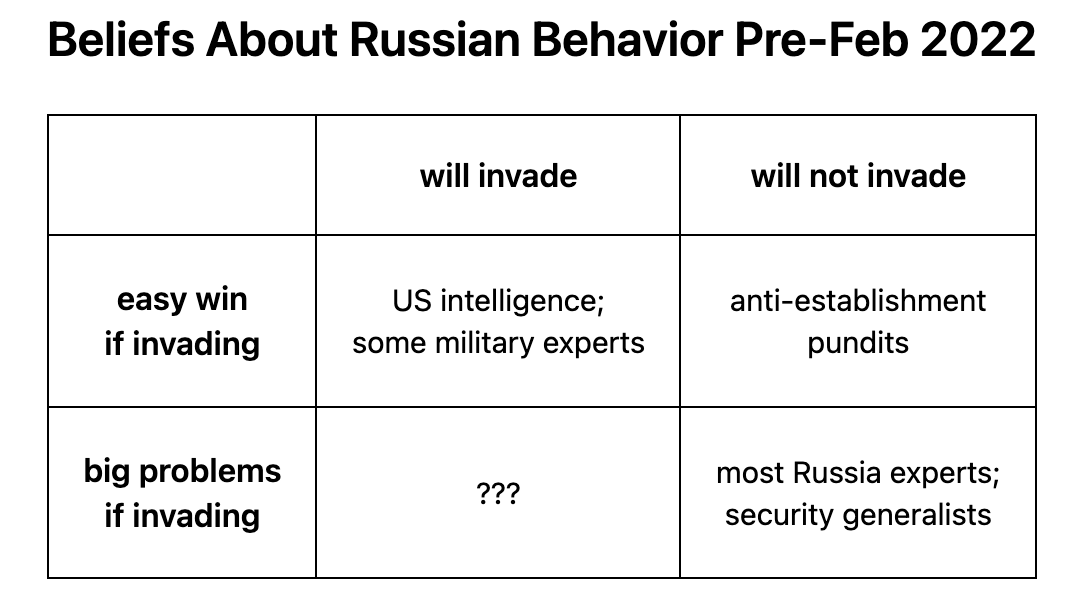
Each cell except the bottom left represents a different kind of failure. The bottom left would have been a remarkable success, but amazingly, I have found very few people to fill it.
Top-left (Russia will invade, and it will have an easy win)
This was largely the US intelligence community’s position. They correctly predicted the invasion but imported the “second army in the world” conventional wisdom about Russian capabilities. The invasion was happening, and it would be a Russian blitzkrieg. A senior German aide to Olaf Scholz captured this perspective at the Munich Security Conference a few days before the invasion, asking Boris Johnson almost wistfully: “What if the Ukrainians don’t resist? What if they collapse quickly?”
As Shaun Walker detailed in a recent Guardian reconstruction based on more than a hundred interviews with intelligence insiders, the CIA and MI6 had by that point assembled a detailed picture of Putin’s war plans: troop movements, intercepted communications, preparations for regime change in Kyiv, even assassination lists. MI6 chief Richard Moore had backed the American assessment as early as November 2021.
But their success on the first question only sharpened their failure on the second. Washington and London were so confident that Russia would invade they were already planning for a swift Russian victory. When Ukraine’s defense minister visited the Pentagon and asked for better weapons, he was turned away; the Americans saw no point in arming a country they expected to fall within days.
A number of military experts familiar with Russian capabilities also fell into this box. Rob Lee (then a PhD student doing granular OSINT work) correctly predicted the invasion early on, but assumed Russia would win easily. In early February he told the British Parliament that Ukraine could not hold off Russia even if it were given “very capable” Western weapons: “If they get into a conventional fight with the Russian military, they are not going to win.” (Lee did not believe Russia could successfully occupy the country and proposed arming the Ukrainians for non-conventional warfare.)
Similarly, Dara Massicot at RAND anticipated the invasion but her January 2022 warning emphasized Russian strengths rather than weaknesses. She argued that a “large-scale multidomain operation would be devastating for the Ukrainian military” and urged Kyiv’s partners to help Ukraine “ride out” the air and missile strikes that would “likely prove decisive.”
Michael Kofman at CNA (now at Carnegie) also correctly anticipated the invasion but predicted Russian success. “[I]t seems plausible that Russian forces would seize Ukraine’s eastern regions,” he wrote a few weeks before the invasion, “as well as the southern port city of Odessa, and encircle Kyiv.” He added: “The question is not what Russia can do militarily in Ukraine, since the answer is almost anything.” The detailed autopsy of battalion understrength and logistics failures co-written with Rob Lee came later, in hindsight.
Top-right (Russia won’t invade, if it did it would be an easy win)
The “crisis is overblown” cell. This was the position uniting the populist right and the anti-interventionist left, a horseshoe closed by shared suspicion of US intelligence and foreign policy establishments. Tucker Carlson dismissed it as a “border dispute” on his show. Glenn Greenwald and Matt Taibbi mocked the invasion warnings as manufactured consent. Taibbi wrote on Feb. 20 that predictions of an imminent invasion had been proved “baseless and embarrassingly incorrect.” Quincy Institute analysts like Anatol Lieven and others confidently framed it as Western provocation.
This placement is a bit awkward since the reflexively anti-establishment crowd were not usually predicting military outcomes. There would be no war to predict. But their dismissiveness was premised on an implicit view of the balance of power, which meant not taking Ukraine seriously as a military actor or a sovereign state. In their view Russia was the dominant party, Ukraine was a Western puppet, and this wasn’t a real conflict but a false flag hyped by the US and its allies. As it turns out, they were confidently wrong.
Bottom-right (Russia won’t invade, if it did it would have big problems)
This was the modal position among Western Russia experts and international relations scholars. Galeotti remained dismissive until nearly the end. Freedman later admitted it “seemed to be such a self-evidently stupid move that I assumed Putin had better options.”
John J. Mearsheimer, a few days before the invasion, said that Putin “did not have any intention of invading Ukraine” and that if he did invade “he’d own it. He’d be an occupier, and that would not work out very well.” This puts him in a space between the top and bottom right. He did predict problems for Russia, but his “occupier” framing suggests he assumed the initial conquest would succeed and the problems would come later. The forecast was an Iraq-like quagmire, not the immediate military failure that ensued. (Mearsheimer also had a stake in the “NATO provocation” frame which probably colored his probability assessment.)
In other words, these experts correctly assessed the dangers, but wrongly assumed Putin was doing a similar cost-benefit calculation, and would thus be deterred.
We’ll come back to these expert predictions in a moment.
Bottom-left (Russia will invade, and it will have big problems)
This is the most interesting and sparsely populated cell because it required defying two separate conventional wisdoms simultaneously. A 2024 postmortem by CSIS reviewed 181 publications and found that “the expert community grossly overestimated Russian military capabilities, dismissed the chances of Ukraine resisting effectively, and presented the likely outcome of the war as quick and decisive.”
They did not identify anyone who got both dimensions right. But they should have looked a little harder. I found a few people who I think might qualify.
On February 12, twelve days before the invasion, military analyst Anders Puck Nielsen published an analysis in the Danish journal Ræson warning that war was the most likely outcome. His reasoning was structural: only a full-scale invasion could give Russia anything resembling a victory, since a diplomatic resolution or a limited operation in the Donbas would leave Moscow worse off than before the crisis; facing a more unified NATO, increased Western military support for Ukraine, and growing Finnish and Swedish interest in alliance membership.
Nielsen predicted that Putin consistently misunderstood Ukraine and that there might be a dangerous delusion in the Kremlin that Ukrainians would welcome Russian forces as liberators. The operation, he cautioned, could easily stall. This made Nielsen one of the rare analysts who got both dimensions right: he predicted the invasion and anticipated that it would not go as Moscow planned.
Maybe the most striking pre-war analysis came from inside the Russian military establishment itself. On February 3, three weeks before the invasion, retired Colonel Mikhail Khodarenok, a former General Staff officer, published a withering piece in Nezavisimaya Gazeta titled “Forecasts of Bloodthirsty Political Scientists.”
In it, Khodarenok systematically dismantled each pillar of the hawks’ case. No one would greet Russian soldiers with flowers. The 2014 Novorossiya project had already proved that even Russian-speaking cities like Kharkiv and Dnipro wanted no part of Moscow’s designs. Russia’s precision munitions stockpiles, numbering in the hundreds, were wholly insufficient against a country the size of France. Air superiority would not be decisive either. The Ukrainian military had been rebuilt since 2014 on a qualitatively different basis. The West would mount a lend-lease operation. Ukrainian cities could become multiple Stalingrads. There would be no blitzkrieg.
On the question of whether Russia would actually invade, his piece reads more as a plea, arguing that war “fundamentally does not serve Russia’s national interests.” But the implication was clear: the decision was being seriously contemplated by people who were catastrophically wrong about what would follow. This places Khodarenok in a particularly interesting cell of our matrix. He got what the war would actually look like almost perfectly right, while stopping just short of asserting that Moscow would be foolish enough to do it.
Khodarenok was not the only member of the Russian military establishment raising alarms. On January 31 retired Colonel General Leonid Ivashov published an open letter addressed to Putin and the Russian people titled “The Eve of War.” Ivashov is a Soviet-nostalgic nationalist and a man known for championing the old system. But he called on Putin to end his “criminal policy of provoking a war” and to resign. He got the biggest call right: war was coming, and it would be a disaster. He correctly predicted massive battlefield casualties and sweeping economic sanctions. He also identified the real threats facing Russia: not Ukraine or NATO but what he called “the unviability of the state model, the complete incapacity and lack of professionalism of the system of power and administration.”
That part of the diagnosis has aged well. But Ivashov also veered into apocalyptic crank territory, warning that NATO would intervene directly, that Turkish armies would be ordered to liberate Crimea and invade the Caucasus, and that Russia faced “the final destruction of Russian statehood and the extermination of the indigenous population.” None of that happened.
There were probably others. From secondhand accounts, the intelligence agencies of Estonia and Poland may have had correct priors on both dimensions, but if so, their assessments weren’t public.
There were doubtless Ukrainians who predicted both. As Shaun Walker’s piece makes clear, Zaluzhnyi seems to belong in the bottom-left cell. He was frustrated that Zelenskyy wouldn’t declare martial law, did quiet contingency planning without authorization, and compared the situation to preparing to fight Mike Tyson after only having had a pillow fight. He clearly expected invasion and expected it to be extremely difficult.
edit 04/18/26: Kindred Winecoff makes a persuasive case for including Biden here in the comments below, though I still have some reservations. And reader “tm” flags Phillips O’Brien’s January 2022 piece in The Critic, “The New Appeasement,” as possibly a good pre-war analysis of how and why the Russian invasion would fail. He argued Russia was economically weak and militarily overrated, and insisted Ukraine would fight. He was right in predicting Russia would fail at the primary task of conquest, not just face difficulties during a subsequent occupation. But on whether Putin would actually invade, he seems to lean against, placing him in the bottom-right.
edit 04/22/26: Martyna Fox shared this April 2021 clip of Nevzorov accurately predicting the consequences of the war.
The Expert Paradox
So what happened here? Why did almost everyone fail?
The Russia experts in the bottom-right weren’t ignorant of course. They understood Russia better than almost anyone. That was, in fact, the source of the problem.
Two days before the invasion, Galeotti wrote: “What is striking is that, even while having a clear advantage on the battlefield, Russian President Vladimir Putin has appeared reluctant to use it. …The much-predicted invasion may still come, but even Putin seems to be hoping he can get the influence and concessions he wants by other means.”
Galeotti later confessed: “Up to a week before the invasion, I was predicting that for all these reasons Putin would not go through with it... My military analysis, it turned out, was spot-on; I went wrong in overestimating Putin’s rationality.” Similarly, in Foreign Policy, Eugene Chausovsky examined Russia’s behavior over time and concluded that “Despite all the hard words from Moscow, Russia’s record shows that an invasion is unlikely.”
These are textbook illustrations of what the forecasting literature calls the expert paradox. In both cases, the depth of knowledge produced the wrong answer. We’ve seen this before: Tetlock’s Expert Political Judgment found that area specialists often underperformed generalists, and this effect was strongest when forecasting discontinuous change in their own domain.
There are several good reasons for this. The first is base rate capture. If you’ve been studying Russia for twenty years and it hasn’t launched a major ground invasion, your intuitions are anchored to that pattern. The intelligence community, working from real-time signals and imagery, wasn’t anchored to their beliefs the same way.
Relatedly, there’s the nothing-new-under-the-sun heuristic. Experts have seen many false alarms, and correctly dismissing them is how they built their reputations. This breeds an appropriate but occasionally costly skepticism toward this-time-is-different claims.
The Soviet collapse is the classic parallel. Sovietologists were famously blindsided, while some generalist forecasters and dissidents saw the fragility more clearly. The Arab Spring caught Middle East specialists similarly flat-footed.
A final factor is paradigm lock-in. Professional communities develop shared frameworks. The “Putin is coldly rational and risk-averse” model was the respectable consensus. It’s one I followed as well. Dissenting meant concluding your colleagues had fundamentally misread the subject of their careers.
But more than that, it seemed to be true. The invasion, to my mind, did not make any sense strategically. If it happened, it would be a disaster for Russia. A couple weeks before the invasion, Adam Casey and I wrote a piece for Foreign Affairs arguing just that: the push for invasion was a product of Putin’s informational bubble and over-confidence (a common characteristic of personalist regimes), and if he went through with it the war would go very poorly for Russia.
In retrospect, we had the right mechanism. We identified the personalist entrenchment dynamic that explains why Putin would make a seemingly irrational decision. But we still couldn’t quite bring ourselves to assert he’d actually do it. That’s the expert trap in miniature: we built the model that predicted the outcome and then flinched at its conclusions.
The depressing implication is that the people most worth consulting on “what’s normal” may be systematically miscalibrated on “what’s possible.” They are good at predicting continuity but bad at predicting change. Prigozhin’s failed thunder run on Moscow, another surprise that blindsided many experts, was another case in point. Experts may be worse at predicting discontinuities than people who are not so anchored in the specifics of their subject.
Beyond the Kremlinology Trap
The error was not confined to Russia experts. People like Lawrence Freedman or John Mearsheimer are not Kremlinologists but security generalists. Freedman is a historian focusing on strategic studies and Mearsheimer is an IR theorist. They both got it wrong.
But like the Kremlinologists, these observers made a similar assumption: that Putin was too rational to undertake such a reckless war, as captured by Freedman’s “self-evidently stupid” comment.
In other words, the bottom-right error wasn’t specific to Russia expertise but to a broader rationalist framework that crossed disciplinary boundaries. The “Putin is rational” assumption infected IR theory and strategic studies as much as Kremlinology. The assumptions that led them astray weren’t confined to area studies but pervaded the broader foreign policy establishment.
As a result, the bottom-right contained two distinct expert groups making the same mistake for different reasons. Russia experts like Galeotti were captured by base rates specific to their domain. Decades of studying Russia made them adjust their intuitions against invasion.
IR theorists like Mearsheimer, on the other hand, were captured by methodological rationalism: the assumption that leaders face binding constraints and won’t make self-destructive choices. (In his Tragedy of Great Power Politics, Mearsheimer explicitly assumes that great powers behave in a rational and strategic manner.)
Both groups arrived at the same wrong prediction from different directions, and that convergence made the consensus feel especially strong.
Country experts and rationalist methodologists both prioritize continuity. Area experts assume continuity of patterns within their domain, while rationalists assume continuity of the basic logic of strategic interaction. Neither framework is fully equipped to analyze what happens when those continuities break.
What’s also striking is that the analysts who correctly predicted the invasion, such as the Five Eyes, Lee, Massicot, and Kofman were among the most technically sophisticated observers of Russian military capabilities. They knew the order of battle, the equipment, and the doctrine. And yet this granular knowledge led them to overestimate Russian performance. The same deep familiarity that let them see the invasion coming also blinded them to Russian capability.
The Entrenchment Factor
A 2025 War on the Rocks piece by Aybars Tuncdogan offers one explanation for why the bottom-right experts underestimated the risk of invasion. His argument is that analysts modeled Russia as a ‘normal’ non-democratic state where domestic elites constrain the leader even if the voters do not. But by 2022, Putin had spent two decades purging, replacing, and subordinating elites to the point where the typical cost-benefit logic no longer applied.
Tuncdogan explicitly calls out Galeotti and Freedman as examples of experts who understood Putin was entrenched but still treated it as “background context rather than a central variable.” They applied a standard state level cost-benefit framework that assumed costs would be politically binding on Putin.
But as he notes, entrenchment fundamentally changes the leader’s cost-benefit calculus. It’s not only that they become irrationally over-confident over time, or become ensconced in an information bubble with fearful underlings. They also rationally calculate they are insulated from any negative fallout, and as a result become more risk-acceptant. The traditional political mechanisms matter here:
Leaders stay in power by keeping a winning coalition happy. New leaders are tightly constrained; long-tenured ones progressively escape those constraints by replacing coalition members with loyalists. Putin’s trajectory fits the pattern: his inner circle has steadily contracted over two decades, with oligarchs and independent power centers giving way to a tight cohort of siloviki whose careers and fortunes depend entirely on his survival.
Echo chamber effects also get stronger with time. Subordinates filter out bad news to protect their positions, so false optimism survives unchallenged. By all accounts Putin expected Kyiv to fall within days; his advisors had apparently assured him Ukrainians would welcome liberation and Zelenskyy would flee. The pattern has persisted throughout the war, with commanders reportedly reluctant to relay casualty figures or operational failures up the chain. Before the war began, Putin’s televised ritual on February 21, 2022, where officials were required to publicly endorse Donbas recognition on command, was a public demonstration of this enforced groupthink.
Another key factor for Russia is nuclear insulation, which means external regime change isn’t a realistic threat. For all the complaints about NATO, its enlargement represented a threat to Russian imperial ambitions, not its existential security. Under a nuclear umbrella the main constraint is domestic; once that’s neutralized, risk tolerance rises dramatically.
The practical takeaway is that as power becomes consolidated, extreme options, including those based on false optimism, become more thinkable and less likely to be blocked. The length of leader tenure should be treated as a proxy for entrenchment, particularly when combined with elite purges, and risk assessments should be adjusted upward accordingly.
If you are now thinking about Xi and Taiwan, you’re on the right track.
What About Next Time?
The Russia experts were doing “normal Kremlinology”, which meant they were well-equipped to predict the next move in the established game, but poorly positioned to see when the game was changing. How does one cultivate sensible contrarians in the face of conventional wisdom?
The intelligence community has tried various solutions (red teaming, devil’s advocates, competitive analysis) with mixed results. Tetlock’s later work on superforecasters suggests the answer might be identifying people with a specific cognitive style: those with a high need for cognition, actively open-minded thinking, comfort with calibrated uncertainty. In other words, something more than domain knowledge.
The problem is you can’t just dismiss expert opinion because they’re too close to the subject. They really are better at explaining and predicting “what’s normal,” which is what you need most of the time. The question is how to build institutional capacity for allowing the weird “what’s possible” voices when it matters.
For those who failed to predict the invasion, the entrenchment variable may be key. Entrenched leaders systematically dismantle constraints that rationalist models assume are binding. Russia experts knew Putin was entrenched but treated it as background context. The IR theorists didn’t account for it at all.
This is not to say Putin is irrational and thus unpredictable. That’s too easy and doesn’t tell us much. Instead, the idea is that entrenchment changes the inputs to rational calculation through filtered information, sycophantic advisors, and inflated assessments of capability. It also shifts the payoff structure: domestic costs are discounted because there’s no one to impose them. The combination produces decisions that look irrational from outside but follow a coherent internal logic.
So the bottom-right experts failed twice over: they assumed Putin had accurate information and faced normal constraints. In fact Putin may have been reasoning correctly from false premises while also facing a different cost structure than analysts assumed.
The more unsettling point is we can’t easily distinguish between “entrenched leader making a rational gamble we don’t understand” and “entrenched leader who has lost touch with reality.” From the outside, their actions look identical.
Taiwan and the Autocratic Resilience Paradox
There’s a bigger lesson here for the scholarship on autocratic resilience. The same mechanisms that make autocrats durable, like purging elites or controlling discourse, also open them to catastrophic miscalculation. The same entrenchment that produces regime resilience produces the capacity for what Freedman called “self-evidently stupid” decisions.
This is one of the biggest problems with personalist rule. Consolidating power not only makes leaders more aggressive, but enables aggression based on the premise that no one is positioned to challenge them. By February 2022, Putin was so insulated he could order a war that virtually everyone outside his bubble, including his own military experts, could see would go badly.
The obvious application is Xi Jinping. He has followed a similar trajectory to Putin by abolishing term limits, purging rivals, and surrounding himself with yes-men to the point where his information environment is heavily filtered. The 20th Party Congress in 2022 was China’s version of Putin’s televised Donbas recognition ritual: a demonstration that the Politburo Standing Committee exists to ratify Xi’s preferences, not constrain them.
If the entrenchment variable matters (and Ukraine suggests it does) then standard predictive frameworks for Taiwan are systematically underestimating the risk. The China experts who have closely followed Xi over the years know him to be a cautious type. They know the PLA’s logistics problems, the economic costs of war, the uncertain amphibious capacity and so on. And they might be making the same error Galeotti and Freedman made. They’re right about the costs, but the question is whether Xi is doing the same calculation, or whether he’s entrenched enough that Freedman’s self-evidently stupid options have become plausible.
Again, this does not necessarily mean Xi is irrational. Entrenchment does build irrational over-optimism, which increases the probability of recklessness. But it also changes the rational cost-benefit calculations of rulers in ways that may be hard to detect for people outside the inner circle.
Long years of consolidated rule, a sycophantic information environment, and nuclear insulation from external threats: we’ve been here before. The one saving grace is Putin’s failure in Ukraine may give Xi pause. But even here, we cannot know whether Xi will learn the wrong lesson. Perhaps from his perspective Putin failed because of poor execution. Surely China can get it right this time.
I suppose here’s the main takeaway. If entrenchment both increases miscalculation risk and makes the autocrat more resilient to the consequences of miscalculation, then we should expect more “self-evidently stupid” decisions from autocrats going forward.
Putin is still in power, and while the country is weaker than in 2022, his regime is stronger and more consolidated. The war has been catastrophic for Russia but not for Putin personally. If Xi is watching, the lesson might be: I can survive my mistakes too.
If we see Xi’s information environment closing further, if we see military assessments becoming more optimistic in official channels, if we see the Politburo becoming even more performatively unanimous, we should keep in mind that those are not just signs of autocratic consolidation. They are the same preconditions that every expert recognized in Russia and almost no one treated as actionable. The people who will get Taiwan right may not be China hands but people asking what happens to aging autocrats with long-standing grievances and pliant elites.
I think we have seen a bit of the same thing again with Iran
I remember saying in January 2022 "call me when Russian forward deploys their S-400 batteries"
I figured they would not want a large number of S-400 giving off their radar emissions within range of NATO SIGINT assets. Why allow a potential adversay to analyze the radar emissions and develop more sophisticated jamming unless not forward deploying them was a worse outcome? (Giving Ukraine a more permissible air environment).
Well they did forward deploy large numbers of S-400s in mid February. And I walked it back! Despite saying that was the evidence I needed to conclude it was likely, when I was presented with the evidence I let my bias take over and discount it.
A lot of us in the west did not appropriately separate our view of the costs of war from the Russian view. How negatively we view loss of life, the opportunity costs of spending so many resources on war, and some sense of 'wars of conquest just don't happen in Europe anymore'.
All of the evidence can be there, but we saw the evidence through our own cultural lense and with our own values. We didn't assess the evidence with Russian culture and Russian values.